
Transparent pricing in fund administration is essential for building trust, managing costs, and meeting regulatory standards. It ensures investors clearly understand fees and their impact on returns, helping avoid disputes and compliance issues. Here’s why it matters and how to implement it effectively:
- Key Benefits: Clear pricing improves budgeting for fund managers, boosts investor confidence, and aligns with SEC requirements.
- Regulatory Focus: The SEC enforces strict rules on fee disclosures, with recent alerts highlighting non-compliance risks.
- Common Fee Structures: Fund administration fees are typically AUM-based, flat, or tiered, covering services like accounting, reporting, and compliance.
- Best Practices: Use standardized reporting templates, conduct regular fee audits, and maintain open communication with stakeholders.
Transparent pricing isn’t just about listing fees – it’s about explaining them. This clarity helps fund managers plan better and reassures investors that their money is handled responsibly. By adopting clear practices and leveraging technology, such as AI hedge fund administration, fund administrators can reduce hidden costs, meet investor expectations, and stay compliant.
Why Pricing Transparency Matters in Fund Administration
Building Trust and Accountability
Clear pricing plays a key role in fostering trust between fund managers, investors, and service providers. When investors can clearly see what they are paying for, it reassures them that the firm is prioritizing their best interests. Walter Mahoney and Travis Morgan from ACA Group underline this point:
"Fee transparency and accuracy are essential for building trust between investment advisers and investors."
Transparency also promotes accountability. It allows fund managers to evaluate whether they are paying fair fees for the services provided or simply covering the cost of a well-known administrator’s brand. Detailed agreements not only help avoid misunderstandings but also create a clear framework for internal stakeholders, minimizing the risk of disputes down the line. Additionally, such clarity helps uncover and address hidden costs more effectively.
Reducing Hidden Costs and Disputes
Transparent pricing sheds light on hidden costs that might otherwise go unnoticed. When investors fully understand the costs associated with their investments – such as trading fees, administrative charges, and other expenses often buried in contracts – they are less likely to feel dissatisfied or consider leaving. Clear pricing also highlights whether costs are driven by efficient automation or a manual, labor-intensive process that scales with staff size.
Unclear pricing can have serious financial consequences. For instance, SEC enforcement actions have revealed situations where investors paid millions more than they should have because advisers failed to properly offset management fees as outlined in fund documents. Independent verification of financial reporting by administrators further boosts investor confidence and ensures compliance with industry standards.
Meeting Regulatory Requirements
Regulatory bodies have turned pricing transparency into more than just a good practice – it’s now a legal obligation. The SEC closely monitors private fund managers’ fee calculations and allocations, paying particular attention to fees charged after the commitment period and any offsets applied. In an April 2024 Marketing Rule Risk Alert, the SEC cautioned against misleading practices, such as failing to disclose key details about fees and expenses used in return calculations, which could lead to enforcement actions.
sbb-itb-9792f40
Why Fee Transparency is the New Reality | Gen II Fund Services
Key Benefits of Transparent Pricing for Fund Managers and Investors
Transparent pricing creates value for both fund managers and investors by simplifying budgeting and fostering trust. Clear cost structures not only help managers plan effectively but also reassure investors that their capital is being handled responsibly.
Better Budget Forecasting
When pricing is straightforward, fund managers can predict costs accurately and avoid surprises down the line. This clarity makes it easier to allocate resources wisely, whether for operational needs or premium services.
For example, smaller funds typically allocate a median of 3.4% of committed capital to operational expenses, while funds exceeding $100 million spend just 1% on the same. Within larger venture capital funds, audit fees alone can account for 13.6% of operating costs. Having this information upfront allows managers to set realistic budgets from the beginning.
Shalin Madan, Co-founder of Formidium, highlights the long-term impact of cost differences:
"If an administrator costs $150,000 a year more than an equally capable alternative, that difference compounds over the life of the fund. Over ten years, the premium may approach $1.5 million, capital that ultimately belongs to LPs."
Another advantage of transparent pricing is the ability to assess whether an administrator uses proprietary accounting systems or third-party platforms. This insight helps managers anticipate whether costs will remain stable or increase as operational needs grow, especially when scaling requires more manual processes.
In addition to aiding internal planning, clear pricing structures also play a role in building trust with investors.
Increased Investor Confidence
Transparent pricing gives investors a clear picture of how their money is being used. This clarity is increasingly important – 91% of asset management firms reported heightened investor due diligence in 2024-2025, with back-office transparency now a key factor for approval. Clear fee structures make it easier to secure LP commitments and foster long-term relationships.
Walter Mahoney and Travis Morgan from ACA Group emphasize the risks of unclear pricing:
"When investors are not provided with clear visibility into how fees are calculated, they may be unaware of the true cost of their investment. This can lead to dissatisfaction and even prompt clients to leave their adviser."
On the flip side, detailed fee agreements reassure investors that the management firm prioritizes their best interests.
This demand for transparency is driving change in the industry. 41% of alternative asset management firms plan to increase outsourcing for fund accounting within the next 12 months. Their goal? To boost operational efficiency and meet investors’ expectations for detailed, real-time cost data. Investors now expect the same level of insight into administrative expenses as they do into fund performance.
Transparent pricing also smooths out the capital-raising process. As the Carta Team explains:
"Institutional LPs view independent, third-party fund administration as a hallmark of strong corporate governance."
Common Cost Structures in Fund Administration
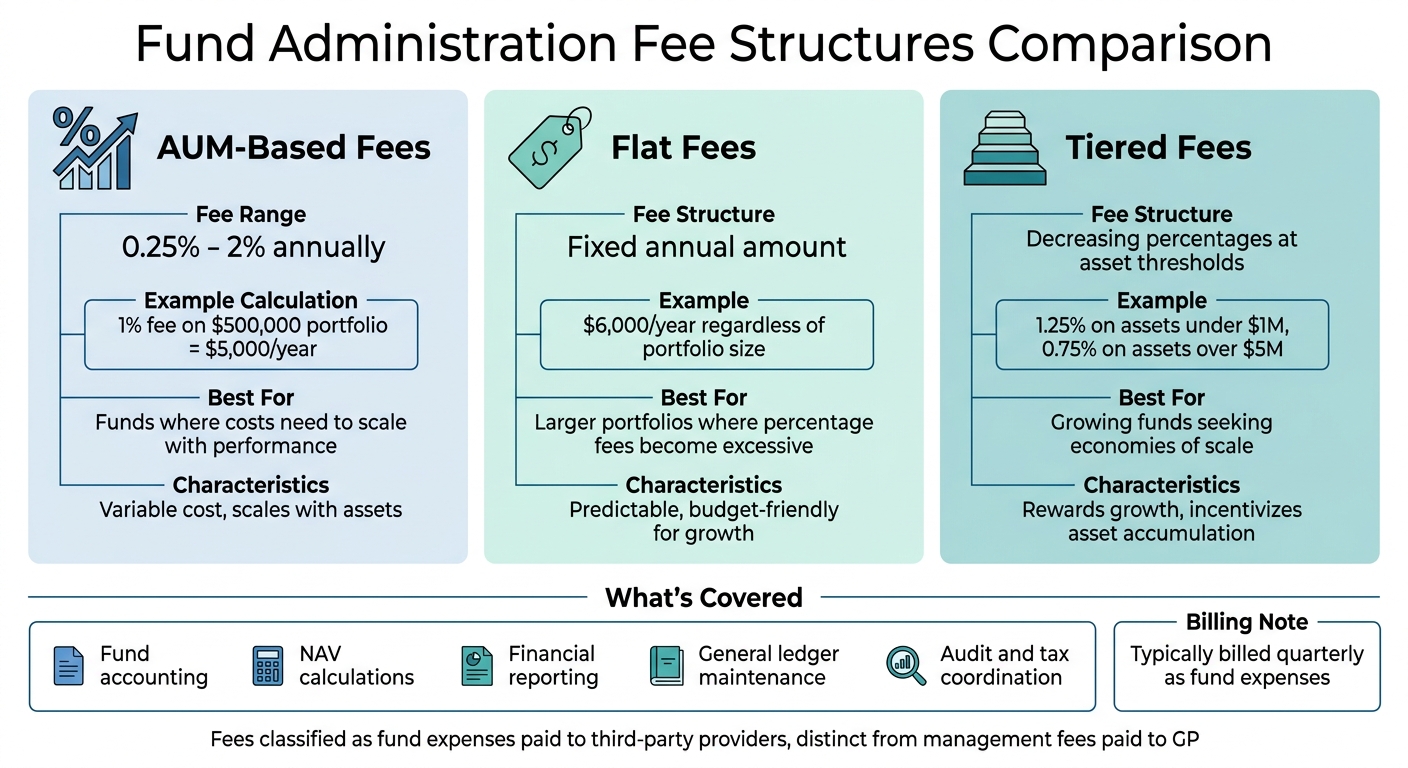
Fund Administration Fee Structures Comparison: AUM-Based vs Flat vs Tiered Pricing
Understanding how fees are structured in fund administration is key to ensuring transparent pricing. Typically, fees are categorized as AUM-based, flat, or tiered.
For instance, an AUM-based fee might be set at 1%, meaning a $500,000 portfolio would incur $5,000 annually in fees. Flat fees, on the other hand, provide predictability – an administrator might charge $6,000 per year regardless of the portfolio’s size. Tiered pricing introduces economies of scale: a fund could pay 1.25% on assets under $1 million but only 0.75% on assets exceeding $5 million.
These fees generally cover essential services like fund accounting, NAV calculations, financial reporting, general ledger upkeep, and coordination with audit and tax providers. Typically billed quarterly, these fees are classified as "fund expenses" paid to third-party providers, distinct from management fees, which are paid to the General Partner. Below, we break down the key fee types and the services they encompass.
Standard Administration Fees
Core administration fees cover the fundamental tasks of managing a fund’s back office. This includes maintaining accurate records, calculating NAV, tracking capital activity, and preparing financial statements. Clearly defined fees not only foster transparency but also help fund managers justify costs to investors.
The choice of fee structure often depends on a fund’s growth strategy. AUM-based pricing is ideal when costs need to scale with fund performance. Flat fees can be more economical for larger portfolios, where percentage-based fees might become excessive. Meanwhile, tiered structures reward growth by lowering the percentage charged as assets increase.
Annual AUM-based fees typically fall between 0.25% and 2%. The Carta Team emphasizes the importance of reasonable fees:
"LPs will question your credibility if you’re ‘trying to mark things up in a way that’s too aggressive.’"
To avoid surprises, administrators should provide a clear breakdown of pricing, covering the scope of services, technology investments, and regulatory oversight, while avoiding hidden add-ons.
Compliance and Reporting Fees
Compliance fees address requirements like AML, KYC, FATCA, and CRS, which vary depending on the jurisdiction. Transparent pricing in this area builds trust by showing a commitment to regulatory standards.
Hedge funds often incur costs for Form PF (SEC) and Commodity Pool Operator (CPO) reports. European funds need to budget for Alternative Investment Fund Managers Directive (AIFMD) compliance. Private equity and venture capital funds face additional expenses for K2 and K3 tax form preparation and adherence to Institutional Limited Partners Association (ILPA) standards.
Funds domiciled in the Cayman Islands must account for CIMA reporting and compliance with the Data Protection Law. New FATCA and CRS 2.0 requirements, introduced in 2026, include stricter penalties and expanded data fields for crypto-related reporting.
The demand for robust compliance is growing. By 2025, 91% of asset management firms reported increased investor due diligence, placing greater demands on back-office reporting. This has led 41% of alternative asset management firms to outsource fund accounting and compliance functions by 2026.
Specialized Fees for Crypto and Listed Funds
Crypto and listed funds come with unique fee structures due to their specialized needs. Transparent pricing in these areas helps set clear expectations for investors.
For listed funds, administrators must provide Net Tangible Asset (NTA) or NAV updates to global exchanges like the CSX and ISE. This involves maintaining accounting records that meet exchange-specific requirements and coordinating with registry and custody partners to deliver exchange-compliant services.
Crypto funds face additional costs for blockchain asset valuation, derivatives, and specialized custody. Management fees for open-ended crypto funds average 1.70%, while crypto Separately Managed Accounts (SMAs) average slightly higher at 1.79%. Incentive fees hover around 20% for crypto funds, while SMAs can reach up to 22%.
Vin Molino, COO and Head of Operational Due Diligence at Crypto Insights Group, highlights a common issue:
"Where the lines get blurry… is when there are those expenses that can be a push and pull between a cost an investment manager should cover, and those which may be borne by a fund."
These "gray-area" expenses include E&O/D&O insurance, technology development (R&D), and marketing. To avoid disputes, clearly document how these costs are divided – whether 50/50 or 60/40 – between the management company and the fund. Additionally, large allocators may seek side letters to secure reduced management fees, incentive hurdles, or caps on pass-through expenses.
With increased SEC scrutiny on valuation and fee transparency, crypto fund managers should plan for third-party valuation specialists to comply with GAAP (ASC 820) requirements for illiquid or digital assets.
Best Practices for Implementing Pricing Transparency
Implementing pricing transparency requires careful planning and execution. When fund managers prioritize clarity in their pricing strategies, they not only strengthen investor relationships but also reduce their exposure to regulatory risks.
Using Standardized Reporting Frameworks
Using standardized templates for fee disclosures helps eliminate confusion. One example is the ILPA Reporting Template (v. 2.0), introduced in January 2025 as part of the Quarterly Reporting Standards Initiative. This template provides a clear structure for reporting fees, expenses, and carried interest. It applies to funds in their investment period during Q1 2026 or those launching on or after January 1, 2026.
Institutional investors value these frameworks because they reveal the full cost of ownership. In fact, 78% of institutional investors have identified transparency and reporting as "very important" or "critical" when deciding whether to invest in successor funds. Emerging managers who adopt ILPA standards early demonstrate an operational readiness that can help them stand out during due diligence.
Top-performing managers go a step further, delivering quarterly reports within 45 days of the quarter’s end – well ahead of the industry norm of 60 days. These reports should break down costs into clear categories like management fees, fund-level expenses (e.g., legal, audit, administration), and portfolio company fees (e.g., monitoring, transaction, and director fees). Additionally, they should explain how management fees are calculated – whether based on committed or invested capital – and disclose any step-down provisions for post-investment periods [[14]](https://ilpa.org/wp-content/flash/ILPA Principles 3.0/inc/html/12.html).
"Adopting the template signals to institutional LPs that you take transparency seriously and that your operations are built to institutional standards." – PipelineRoad
Routine audits can further strengthen the credibility of these standardized reports.
Conducting Regular Fee Audits and Reviews
Regular audits are essential for catching discrepancies before they escalate into disputes. These reviews can uncover calculation errors that might lead to overcharges. They also ensure that preferred return thresholds and fee offsets are applied consistently.
The SEC has been paying closer attention to "misleading practices", including the failure to disclose material information about fees and expenses used in return calculations. For instance, in August 2025, a New York-based Registered Investment Adviser faced SEC enforcement and was ordered to pay $683,000 in monetary relief to investors. The charges stemmed from a breach of fiduciary duty, where the adviser failed to disclose portfolio company transaction fees and improperly applied fee offsets.
To avoid similar pitfalls, fund managers should assign fee reviews to a compliance team or an independent third party separate from those responsible for fee calculations and legal drafting. Involving the finance team during the drafting of Limited Partner Agreements can also ensure that fee terms are both practical and enforceable. Regular audits, paired with detailed records, help prevent errors and maintain consistency in fee application.
Maintaining Clear Communication with Stakeholders
Transparency goes beyond presenting numbers – it’s also about providing context and ensuring accessibility. Quarterly reports should include a letter that explains performance data, discusses market conditions, and addresses any challenges.
"The quarterly report is not just a document. It’s a touchpoint, one that either builds trust or erodes it, four times a year, for the life of the fund." – PipelineRoad
Investor portals can further enhance communication by offering on-demand access to financial statements, capital account metrics, and a clear breakdown of how fees affect capital accounts. This reduces the need for manual requests and allows investors to monitor their investments in real time. During fund formation, providing Limited Partners (LPs) with a fee model or budget that outlines how management fees will be calculated over the fund’s life can also help set clear expectations [[14]](https://ilpa.org/wp-content/flash/ILPA Principles 3.0/inc/html/12.html).
Ongoing collaboration with independent auditors ensures that fee calculations and fair value measurements meet regulatory standards. Disclosing related-party transactions, such as management fees, portfolio company transaction fees, and co-investment dealings, helps mitigate conflicts of interest. When fee offsets apply, clearly reporting any portfolio company fees that reduce the management fee owed by LPs is another way to maintain trust.
Clear and consistent communication not only fosters trust but also aligns with regulatory requirements. This approach lays the groundwork for practices like those employed by Charter Group Fund Administration, which will be discussed in the next section.
Charter Group Fund Administration‘s Approach to Transparent Pricing
Charter Group Fund Administration sets a strong example in pricing clarity, offering clients full visibility into fund data and associated costs. Using an advanced automated platform, the firm ensures transparent reporting, which forms the backbone of its custom pricing models.
Tailored Pricing Models for Different Fund Types
Charter Group tailors its pricing to suit various fund types:
- Hedge Funds: For funds based in the Cayman Islands or BVI, services include accounting, NAV calculations, and compliance support.
- Crypto Funds: These funds benefit from specialized services that address unique fee structures and the complexities of valuing blockchain assets and derivatives.
- Listed Funds: The firm handles accounting records and provides ongoing updates for Net Tangible Asset (NTA) or NAV figures, ensuring compliance with global exchanges like the CSX and ISE.
Charter Group’s client-centered approach also extends to CTAs, offering either full administration services or independent reviews to strengthen reporting accuracy. These customized solutions seamlessly integrate with NAV calculations and compliance support, ensuring that all aspects of fund administration work together efficiently.
Combining NAV Calculations with Compliance and Fee Transparency
Charter Group enhances its pricing models by integrating fee transparency with precise NAV and compliance services. This integration ensures that fees, NAV, and returns undergo independent reviews, with third-party validation adding an extra layer of reliability.
"Having an independent party calculate returns enhances the integrity of your fund and reported returns." – Charter Group Fund Administration
The firm’s automated platform minimizes manual errors and delivers clear, accessible reports to stakeholders. For crypto funds, the platform is particularly adept at handling the intricate valuation demands of blockchain assets and derivatives. By aligning transparent pricing with NAV calculations, Charter Group ensures that fees are applied accurately and remain fully auditable, fostering both regulatory compliance and investor trust.
Conclusion
Transparent pricing plays a crucial role in fostering trust and maintaining confidence in the market. When fund managers and administrators clearly outline fee structures, they eliminate unexpected charges, minimize disputes, and empower investors to make well-informed decisions.
Opaque pricing, on the other hand, not only wastes time but can also erode trust. As Harold A. Pollack, PhD, MPP, from the University of Chicago, explains:
"The sheer opacity and complexity of… prices wastes… time and, at times, undermines the legitimacy of the system itself".
Clear pricing practices, as discussed earlier, help ensure the integrity of reported returns and bolster investor confidence in fund performance.
For fund managers, adopting transparent pricing isn’t just about trust – it’s also about operational efficiency. It enables better budget planning, simplifies compliance processes, and reduces administrative headaches. With a predictable fee structure, managers can shift their focus to activities that generate value rather than resolving fee-related disputes. This approach also improves cost management across funds, regardless of their size.
The benefits of transparency are amplified by advancements in automation. Modern fund administration systems now offer real-time access to critical data like fee calculations, net asset value (NAV), and compliance reports – all centralized in a single platform. Combined with increasing regulatory demands, this shift is making transparent pricing the new norm in the industry.
FAQs
What fee details should investors see upfront?
Investors need clear, upfront information about management fees. This includes the percentage charged – often ranging from 0.25% to 2% – as well as how these fees are calculated, such as being based on assets under management (AUM). Additionally, any potential discounts or fee offsets should be disclosed. Providing this transparency helps ensure investors have a full understanding of the costs tied to their investments.
How can a fund spot hidden admin costs early?
Funds can spot overlooked administrative costs early by closely reviewing their operations and pinpointing what influences pricing variations – things like how the organization is structured and where spending is prioritized. By digging deeper than standard services like accounting and reporting, they can reveal cost drivers that might otherwise go unnoticed.
How often should fee calculations be audited?
Fee calculations need regular audits to ensure they stay accurate and clear, especially when under regulatory review. While many experts suggest conducting these audits annually, funds with higher activity levels or more complex structures might require more frequent checks.