
Navigating data protection laws can be tricky, especially for fund administrators managing investor data across jurisdictions. The GDPR (EU) and Cayman Data Protection Act (Cayman Islands) share some principles but differ in key areas like breach notifications, jurisdictional reach, and data subject rights. Here’s what you need to know:
- GDPR applies globally to organizations offering services to EU residents or monitoring their behavior. It sets strict standards for data protection, including a 72-hour breach reporting requirement and explicit consent for data processing.
- Cayman Data Protection Act applies to entities established in the Cayman Islands, regardless of where data is processed. It includes a 5-day breach notification rule and allows implied consent in certain cases.
- Key Differences: GDPR imposes direct liability on both controllers and processors, while Cayman law places primary responsibility on controllers. GDPR also mandates data portability and stricter consent mechanisms.
Quick Comparison
| Feature | GDPR | Cayman Data Protection Act |
|---|---|---|
| Scope | Global (if targeting/monitoring EU residents) | Entities established in Cayman Islands |
| Breach Notification | 72 hours to authority | 5 days (reportable breaches) |
| Consent | Explicit (opt-in required) | Implied allowed in some cases |
| Data Portability | Required | Not required |
| Liability | Controllers & processors | Primarily controllers |
| Maximum Fine | €20M or 4% of global revenue | KYD 250,000 (~$300,000) |
Fund administrators must align with both frameworks by updating privacy notices, refining data processing agreements, and adopting breach response plans tailored to meet the stricter requirements of each law. Prioritize GDPR’s higher standards to simplify compliance across jurisdictions.
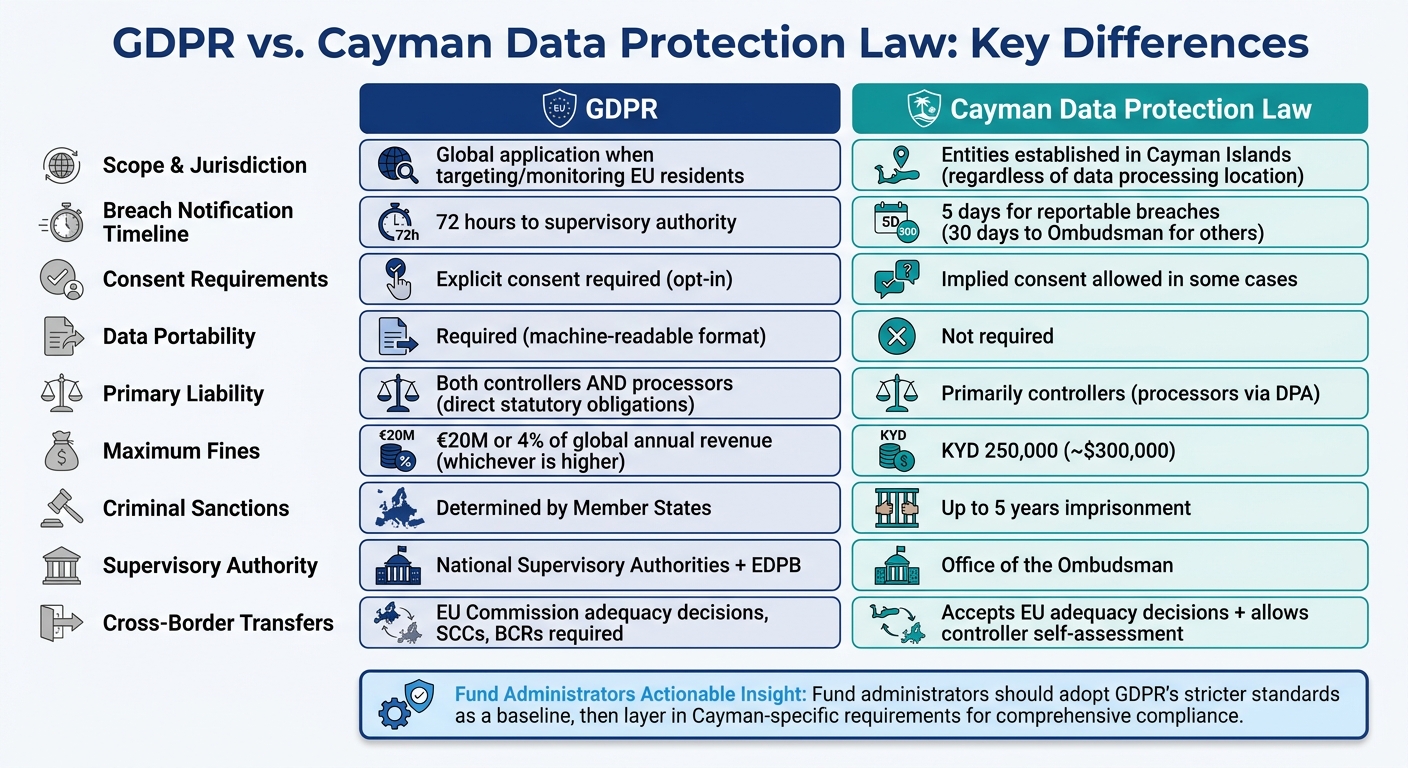
GDPR vs Cayman Data Protection Law: Key Differences for Fund Administrators
Scope and Territorial Application
Fund administrators need to recognize the distinct yet overlapping jurisdictions of GDPR and Cayman Islands law. While GDPR focuses on protecting data subjects within the EU, Cayman Islands law applies to entities based locally.
GDPR‘s Extraterritorial Reach
The GDPR isn’t confined to the borders of the EU. It applies to any organization – no matter where it’s located – that offers goods or services to individuals in the EU or monitors their behavior within the EU. This means a Cayman-based administrator must adhere to GDPR when engaging with EU residents, whether through marketing efforts or behavioral tracking.
As Annie Greenley-Giudici from TrustArc highlights:
All organizations that offer goods or services to people in Europe, or monitor the behavior of individuals in Europe must still comply with the EU GDPR.
Importantly, GDPR is concerned with the location of the data subjects (EU residents), not their nationality or where the organization is headquartered.
Cayman Data Protection Law’s Jurisdictional Limits
The Cayman Islands Data Protection Law, on the other hand, applies to all entities established in the Cayman Islands, including investment funds, whether or not they are registered with the Cayman Islands Monetary Authority. The law is triggered by the local presence of the entity, regardless of where the personal data is processed or the nationality of the individuals involved.
Campbells explains this clearly:
The Law regulates the processing of all personal data in the Cayman Islands and will impact all entities established in the Cayman Islands… The Law applies irrespective of where personal data is processed and applies to personal data irrespective of individual citizenship or residency.
This creates a dual compliance challenge. A Cayman-based fund with EU investors must align with GDPR when targeting or monitoring EU residents, while also adhering to Cayman Islands law for all data processing activities conducted locally. These overlapping requirements demand careful navigation to ensure compliance with both frameworks simultaneously.
sbb-itb-9792f40
Data Subject Rights and Consent Requirements
Both GDPR and Cayman Islands Data Protection Law give individuals control over their personal data, but the level of detail and implementation varies. For fund administrators managing investor data across jurisdictions, understanding these differences is essential.
Rights Under GDPR
GDPR provides individuals with extensive rights over their personal data. These include:
- Access: Individuals can request access to their personal data.
- Rectification: They can correct inaccurate information.
- Erasure: Also known as the "right to be forgotten."
- Restriction of Processing: Limits how their data is handled.
- Objection to Processing: They can refuse certain uses of their data.
- Data Portability: This enables individuals to receive their data in a structured, machine-readable format and transfer it to another data controller.
The portability feature is particularly relevant in competitive financial markets, where investors may switch fund administrators. GDPR also requires explicit consent for many processing activities, meaning individuals must actively agree – silence or pre-ticked boxes don’t count. Fund administrators need to incorporate detailed consent mechanisms in subscription documents and ongoing communications to comply with these standards.
Rights Under Cayman Data Protection Law
The Cayman Islands Data Protection Law adheres to eight data protection principles that align with international norms but lack the granularity of GDPR. While the law ensures personal data is processed in line with individual rights, it doesn’t list specific rights as comprehensively as GDPR. For instance, there is no data portability requirement, meaning investors cannot demand their data in a transferable format.
As Ogier explains:
"Under the DP Law, any entity established in the Cayman Islands that handles any individual’s personal information will have certain obligations with respect to that information and must ensure that such individual is formally apprised of by whom, and for what purpose, any of their personal data is being used."
Unlike GDPR, the Cayman law does not mandate detailed consent mechanisms.
Consent Standards and Mechanisms
The differences in rights lead to distinct consent practices. GDPR enforces strict, explicit consent for many activities, requiring clear opt-in measures like detailed cookie banners and granular checkboxes. In contrast, Cayman law allows implied consent in some cases, provided the purpose has been disclosed.
For fund administrators operating across both jurisdictions, this creates practical challenges. EU investors must go through explicit opt-in procedures for actions like marketing or sharing data with third parties. Meanwhile, Cayman law permits a more simplified approach for local compliance. To navigate this, fund administrators should:
- Update subscription documents for new investors.
- Distribute revised privacy notices to existing investors.
This dual consent framework ensures compliance while minimizing friction during onboarding. Adjusting data management practices to align with these differing consent requirements is crucial for seamless operations across jurisdictions.
Data Security and Breach Notification
Strong security protocols not only safeguard sensitive data but also help fund administrators maintain compliance with regulations in both the EU and the Cayman Islands. Navigating these requirements demands a clear understanding of the obligations set out by each jurisdiction.
GDPR’s Security Standards
The GDPR sets high expectations for data protection, holding both data controllers and processors accountable for security measures. Under Article 32, fund administrators acting as processors must adopt specific technical and organizational safeguards, such as pseudonymization, encryption, confidentiality protocols, and regular testing.
What makes GDPR particularly stringent is that administrators can face direct liability for security lapses, even if their contracts with controllers include protective clauses. Non-compliance isn’t taken lightly – unintentional violations can result in fines of up to €10 million or 2% of annual revenue, while intentional breaches can lead to penalties as high as €20 million or 4% of annual revenue. These aren’t just recommendations; they are enforceable obligations.
Cayman Data Protection Law’s Controller-Focused Approach
The Cayman Islands’ approach shifts much of the responsibility to data controllers, as highlighted by Campbells:
Data security requirements under the Law in this context only extend liability to data controllers.
This means that the fund itself, rather than the administrator, is primarily responsible for ensuring data security. Fund administrators, often acting as processors, handle sensitive items such as subscription agreements, KYC documentation, and FATCA data. Instead of imposing direct statutory requirements on processors, Cayman law relies on Data Processing Agreements (DPAs) to define the controller’s instructions and the processor’s obligations.
Boards overseeing funds must decide whether existing contractual measures, like GDPR compliance clauses, meet the standards required under Cayman law.
Breach Notification Timelines
The differences in liability also extend to breach notification requirements, which can create operational challenges for fund administrators working across both jurisdictions.
Under GDPR, breaches must be reported within 72 hours to the relevant supervisory authority. By contrast, Cayman law allows 30 days for notifications to the Ombudsman, or 5 days in cases of reportable breaches. For administrators managing compliance in both regions, aligning incident response plans with GDPR’s stricter 72-hour rule is the safest approach. This "highest common denominator" strategy avoids procedural confusion and ensures compliance with both frameworks.
Here’s a quick comparison of the two frameworks:
| Feature | GDPR | Cayman Data Protection Law |
|---|---|---|
| Primary Liability | Controllers and processors share direct liability | Liability rests primarily with the data controller |
| Specific Measures | Requires pseudonymization, encryption, and regular testing | Focuses on "appropriate" measures without specific mandates |
| Breach Notification | 72 hours to the supervisory authority | 30 days to the Ombudsman; 5 days for reportable breaches |
| Processor Obligations | Processors have direct statutory obligations | Obligations are defined by the DPA with the controller |
To stay compliant, administrators need to ensure their agreements include clear breach reporting responsibilities and prepare incident response plans that meet both the GDPR’s 72-hour and Cayman’s 5-day requirements.
Enforcement, Penalties, and Supervisory Authorities
When navigating the complex landscape of breach notification standards, it’s essential to grasp how these rules are enforced and the consequences of non-compliance. For fund administrators, understanding the differences between the enforcement structures of the GDPR and the Cayman Islands Data Protection Law is crucial. These frameworks vary significantly in terms of regulatory authorities, financial penalties, and criminal liabilities.
GDPR Penalties and Supervisory Authorities
Under the GDPR, enforcement is handled by independent Supervisory Authorities in each EU Member State, coordinated by the European Data Protection Board (EDPB). For businesses operating across multiple EU countries, the One-Stop-Shop mechanism simplifies compliance by allowing them to work with a single "lead" authority.
GDPR fines are divided into two tiers based on the severity of the violation. Tier 1 violations can result in fines of up to €10 million or 2% of global annual turnover – whichever is higher. Tier 2 violations carry even steeper penalties, with fines reaching €20 million or 4% of global annual turnover.
One of the GDPR’s defining features is that fines can be calculated based on the global turnover of the entire corporate group, not just the entity responsible for the breach. Recent examples highlight the potential financial impact:
- Meta Platforms Ireland Limited: Fined €1.2 billion in May 2023 for improper cross-border data transfers.
- Amazon Europe: Fined €746 million in July 2021 for non-compliant targeted advertising.
- TikTok Limited: Fined €345 million in September 2023 for failing to protect children’s privacy by defaulting teen accounts to public settings.
In addition to financial penalties, Supervisory Authorities can impose corrective measures like warnings, reprimands, orders to cease processing, or even temporary and permanent bans on data processing. These penalties underscore the operational and compliance risks fund administrators must manage when operating under the GDPR.
Cayman Data Protection Law Penalties and the Ombudsman
The Cayman Islands Data Protection Law is enforced by the Office of the Ombudsman, which typically seeks to resolve complaints through collaboration before resorting to penalties.
Administrative fines under the Cayman framework are capped at KYD 250,000 (roughly $300,000) per penalty notice – significantly lower than GDPR fines. However, criminal sanctions can include up to five years of imprisonment for certain breaches, such as failing to comply with an enforcement notice. Moreover, if a breach is linked to the consent, negligence, or involvement of a director, secretary, or similar officer, that individual can face personal liability and prosecution.
| Feature | GDPR | Cayman Data Protection Law |
|---|---|---|
| Primary Authority | National Supervisory Authorities (SAs) | Office of the Ombudsman |
| Maximum Administrative Fine | €20M or 4% of global turnover | KYD 250,000 (~$300,000) |
| Criminal Sanctions | Determined by Member States | Up to 5 years imprisonment |
| Individual Liability | Focuses on Controller entity | Extends to directors/officers |
For fund administrators navigating both regimes, meeting the GDPR’s higher data processing standards while addressing Cayman-specific requirements is essential. A well-rounded compliance strategy can help mitigate risks, including the possibility of criminal sanctions. These enforcement differences highlight the importance of tailoring compliance efforts to meet jurisdictional demands effectively.
Cross-Border Data Transfers
Fund administrators need a clear understanding of how EU and Cayman regulations govern cross-border data transfers. While their methods differ, both aim to safeguard personal data during international transfers.
GDPR’s Adequacy Framework
Under the GDPR, transferring data outside the European Economic Area (EEA) is restricted unless specific conditions are met. The European Commission determines whether a country offers an "adequate" level of protection through formal adequacy decisions. For countries lacking this designation, organizations must use alternative measures like Standard Contractual Clauses (SCCs) or Binding Corporate Rules (BCRs) to ensure lawful transfers.
"The GDPR… has strict provisions in place for safeguarding data when it is transferred outside Europe." – InCountry
Failing to comply with these regulations can lead to substantial financial penalties, reaching €20 million or 4% of global annual turnover, whichever is higher. The European Commission plays a central role in deciding which countries meet adequacy standards, making this a top-down approach.
The Cayman Islands, however, takes a more adaptable route for cross-border data transfers.
Cayman’s Approach to Cross-Border Data Transfers
The Cayman Islands Data Protection Act aligns with EU standards but offers more flexibility. The Cayman Ombudsman automatically recognizes all EU Member States and any country with an existing European Commission adequacy decision as providing sufficient protection. This allows fund administrators to transfer data to these jurisdictions without needing additional safeguards.
A key difference is that the Cayman DPA permits controllers to self-assess the adequacy of a non-listed country’s protection. This assessment considers factors like the nature of the data, local laws, and international obligations.
"We will accept SCCs in the understanding that the intent of the parties is to interpret references to EU law as to the equivalent under the DPA." – Cayman Islands Ombudsman
The Ombudsman also allows the use of EU Standard Contractual Clauses without modification and may authorize specific transfers, offering flexibility for businesses working with international partners.
| Feature | GDPR Framework | Cayman Data Protection Law |
|---|---|---|
| Primary Adequacy Authority | European Commission | Cayman Ombudsman (adopts EU decisions) |
| Self-Assessment | Generally not allowed; relies on SCCs/BCRs | Allowed; based on DPA criteria |
| Standard Contractual Clauses | Requires EU-specific SCCs | Accepts EU SCCs without amendment |
| Enforcement Authority | EU Member State Supervisory Authorities | Cayman Islands Ombudsman |
Navigating these frameworks is essential for fund administrators to maintain compliance. The contrast between the EU’s stricter approach and the Cayman’s more adaptable regulations highlights the need for a cohesive strategy.
For fund administrators, such as those at Charter Group Fund Administration in the Cayman Islands, this dual framework presents both challenges and opportunities. By aligning GDPR-compliant Data Processing Agreements with Cayman requirements, administrators can streamline their processes, making it easier to work with international service providers.
Compliance Considerations for Fund Administrators
Fund administrators in the Cayman Islands must adhere to both the Cayman Data Protection Law and GDPR when working with international clients. Since these two frameworks share many similarities, adopting a unified compliance strategy can simplify operations while meeting all legal obligations. Here’s how to align your practices with both frameworks.
Adopting Unified Compliance Standards
The Cayman Data Protection Law is closely aligned with GDPR, making GDPR a practical starting point for compliance. If your firm already complies with GDPR, you can simply modify your privacy policies to include references to the Cayman Islands Ombudsman and local requirements.
"If the investment fund is already subject to GDPR then the investment fund may have already adopted a GDPR compliant privacy notice. If that is the case, then a few minor amendments to the privacy notice to reflect the Data Protection Law are all that are needed." – Harneys
Begin by reviewing your Data Processing Agreements (DPAs) with your fund clients. These agreements should clearly outline how personal data will be managed, the security measures in place, and your responsibilities for breach notifications and data subject requests. If your DPAs already meet GDPR standards, your fund’s board can evaluate whether they also satisfy Cayman-specific requirements or need slight adjustments.
Offering memoranda and subscription agreements should also be updated to include clear privacy notices. These notices must outline investor rights under both laws, explain the lawful basis for processing data, and describe how personal information will be safeguarded. For entity investors, include representations confirming that they’ve shared the privacy notice with their beneficial owners and directors.
Additionally, establish formal data retention schedules that specify how long data will be stored and when it will be destroyed. Create consistent processes for handling data subject access requests, keeping in mind your dual roles as both a data processor (e.g., managing subscription agreements) and a data controller (e.g., conducting KYC and AML checks). Your compliance plan should address these roles distinctly and comprehensively.
Managing Breach Notifications and Data Subject Requests
One key difference between GDPR and the Cayman Data Protection Law lies in the timelines for breach notifications. GDPR mandates notification within 72 hours, while the Cayman law requires reporting to the Ombudsman within 5 days of becoming aware of a reportable breach.
"Compliance with the GDPR equates to compliance with the Law in broad terms but there are additional obligations under the Law (e.g. the requirement to notify the Ombudsman in the event of a reportable breach within 5 days)." – Campbells
To meet these requirements, ensure your incident response plan covers both frameworks. This plan should:
- Identify the team responsible for breach assessment and reporting.
- Outline notification procedures for both EU supervisory authorities and the Cayman Islands Ombudsman.
- Default to the stricter 72-hour timeline to ensure compliance across jurisdictions.
- Specify the required information for each regulatory authority.
- Include steps for notifying affected data subjects.
For data subject requests, rely on guidance from the Cayman Islands Office of the Ombudsman, which follows the UK Information Commissioner’s Office (ICO) interpretation of GDPR. Simplify communication with investors by using portals to provide easy access to privacy notices and updates.
Charter Group Fund Administration, a Cayman-based firm, demonstrates how to manage these dual requirements effectively. By maintaining GDPR-compliant procedures while addressing Cayman-specific obligations, they ensure compliance while streamlining international data management. This approach reduces the complexity of adhering to multiple frameworks and supports smooth cross-border operations.
Conclusion
The Cayman Data Protection Law and GDPR share a similar foundation, but fund administrators need to pinpoint the differences that require specific compliance measures. While adhering to GDPR provides a solid starting point, the Cayman framework introduces distinct obligations. For instance, the Cayman law mandates a 5-day breach notification to the Ombudsman, compared to GDPR’s 72-hour requirement. Additionally, the Cayman law emphasizes a controller-focused liability structure, placing more responsibility on the funds themselves rather than their administrators.
"Compliance with the GDPR equates to compliance with the Law in broad terms but there are additional obligations under the Law (e.g. the requirement to notify the Ombudsman in the event of a reportable breach within 5 days)." – Campbells
These differences shape practical approaches to compliance. Fund administrators should update Data Processing Agreements and privacy notices to align with both GDPR and Cayman requirements. They should also adopt breach notification protocols that default to the stricter 72-hour timeline and establish separate procedures for their dual roles – acting as data processors for fund operations and as data controllers for KYC and AML processes.
Navigating these regulatory nuances is critical as global data protection enforcement ramps up and cross-border transfer rules grow tighter. Administrators who can effectively manage both frameworks will be in a stronger position to support international clients while reducing regulatory risks. The strategy lies in using GDPR compliance as a foundation and layering in Cayman-specific requirements to ensure smooth operations and legal compliance.
For fund administrators needing expert help with these challenges, Charter Group Fund Administration provides tailored support for offshore operations.
FAQs
Do I need to follow GDPR if my fund is based in Cayman?
Funds based in the Cayman Islands are not obligated to comply with GDPR. Instead, they adhere to the Cayman Islands’ own data protection framework, primarily governed by the Data Protection Act. This legislation outlines the rules for managing personal data within the jurisdiction.
However, if a fund engages with clients or entities located in the EU, GDPR compliance might come into play. This would depend on the nature of the interaction, but compliance isn’t automatically required just because the fund is based in the Cayman Islands.
Who is liable for a data breach under Cayman law vs GDPR?
Under Cayman Islands law, the responsibility for a data breach lies with the data controller or processor deemed at fault. The Data Protection Act mandates controllers to establish proper security measures and report breaches promptly. Failure to comply can lead to administrative penalties.
Under the GDPR, the data controller bears the primary accountability. This includes strict obligations to safeguard personal data and meet notification requirements. Non-compliance can result in hefty fines and potential compensation claims.
What’s the safest breach-notification timeline to use for both?
The safest approach for breach notification under both GDPR and the Cayman Islands’ Data Protection Law is to act within 72 hours of discovering a data breach. GDPR explicitly requires notification within this timeframe unless the breach poses no risk to individuals’ rights. While the Cayman Islands’ law follows global standards, it doesn’t specify an exact deadline, making the 72-hour window a sensible and compliant choice for both frameworks.