
NAV (Net Asset Value) is a critical metric for funds, calculated as (Total Assets – Total Liabilities) ÷ Shares Outstanding. It determines share prices, fees, and investor decisions. Errors in NAV calculations can lead to financial losses, regulatory scrutiny, and reputational damage.
Key takeaways from the article:
- Importance of NAV Accuracy: Errors, even minor, can disrupt investor redemptions, fees, and compliance.
- Continuity Risks: Failures in systems, data feeds, or compliance processes can cause delays or inaccuracies.
- Safeguards: Backup systems, automation, and independent reviews reduce risks.
- Regulatory Oversight: SEC and other regulators emphasize robust continuity plans to ensure NAV reliability.
With global assets under management projected to reach $145.4 trillion by 2025, maintaining NAV accuracy through strong continuity planning is essential for fund managers.
How Continuity Failures Affect NAV Calculations
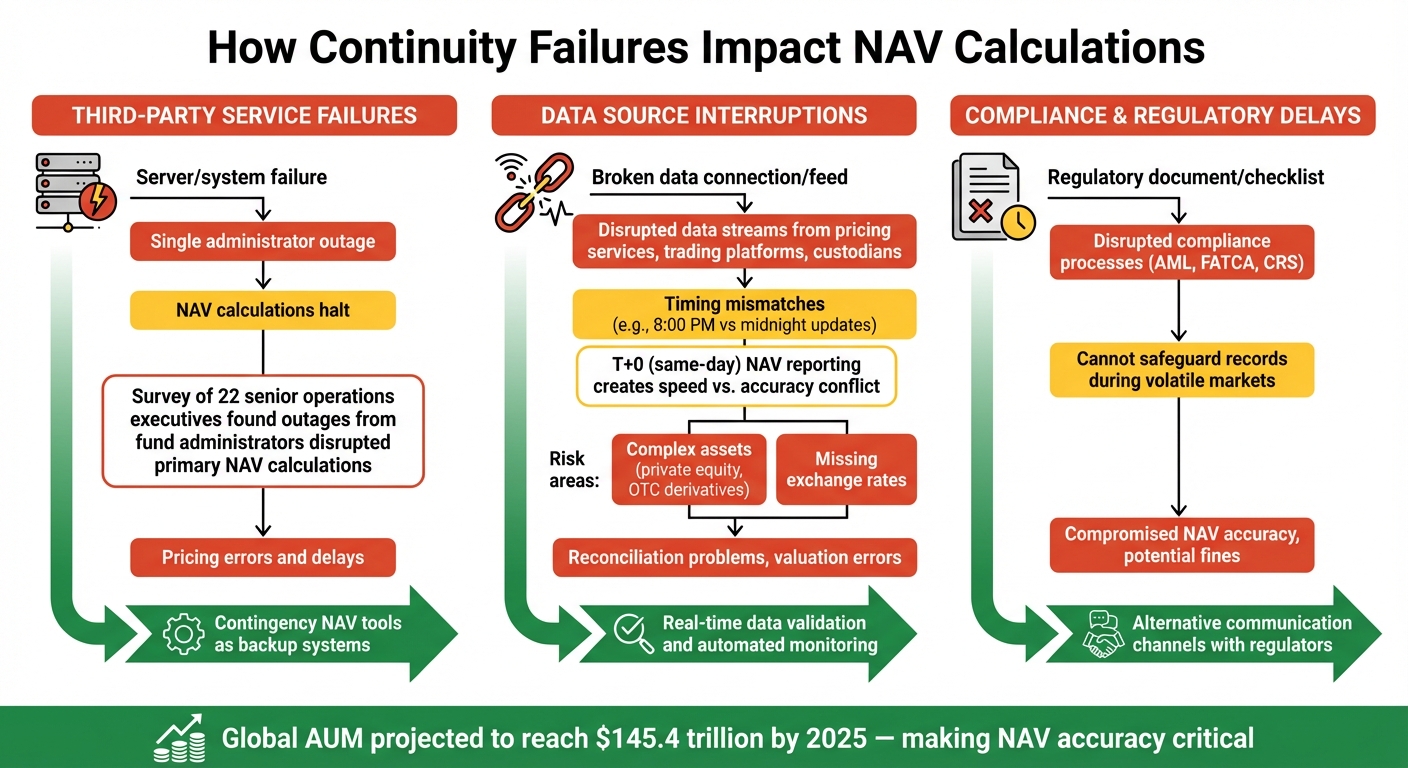
How Continuity Failures Impact NAV Calculation Accuracy
When business continuity plans falter, the impact on NAV (Net Asset Value) calculations can be swift and damaging. Even minor disruptions to critical systems or data feeds can result in inaccurate valuations, delayed reporting, and compliance issues. Recognizing these risks helps fund managers and administrators strengthen their operations to avoid such pitfalls. Below, we explore how different types of disruptions can undermine NAV accuracy.
Third-Party Service and System Failures
Relying heavily on a single administrator creates a significant vulnerability. If this provider experiences an outage, NAV calculations can grind to a halt. According to a survey of 22 senior operations executives at asset management firms, outages or delays from fund administrators often disrupted primary NAV calculations, increasing the chances of pricing errors and delays. The stakes are high, as noted by Celent:
A pricing error could pose significant reputational and financial damage for firms.
To mitigate these risks, many asset managers are adopting "contingency NAV" tools. These backup systems ensure that a functional NAV can still be calculated during a primary provider outage. As one industry report emphasized:
Investing in oversight tools that could detect errors before costly reconciliations was no longer a ‘nice to have.’ It was a ‘need to have’.
Data Source Interruptions
Accurate NAV calculations rely on uninterrupted data streams from pricing services, trading platforms, and custodians. Any disruption or delay in these feeds can lead to reconciliation problems and valuation errors. For instance, differences in update schedules – such as one feed updating at 8:00 PM while another updates at midnight – can create timing mismatches that complicate reconciliation.
Failures in APIs or outdated integration systems add another layer of risk. If real-time data transmission breaks down, or if legacy systems can’t handle modern integration demands, accounting platforms may receive incomplete or outdated information. Complex assets like private equity holdings or OTC derivatives are particularly vulnerable, as interruptions often require manual intervention and expert judgment, which can increase error rates. Additionally, missing real-time exchange rate updates can lead to distorted NAV figures due to unaccounted currency fluctuations.
The industry’s push for T+0 (same-day) NAV reporting has only heightened these challenges. As Don Harder from FundCount pointed out:
The push for speed can conflict with the need for accuracy, creating a delicate balancing act in operations.
When data interruptions occur, operations teams are forced to work under tight deadlines to identify and resolve errors, which complicates oversight. If shadow accounting misinterprets data formats, it can lead to incorrect records or mismatched information.
Compliance and Regulatory Delays
Beyond technical and data-related challenges, compliance interruptions can also jeopardize NAV accuracy. Regulatory reporting is a critical part of business continuity planning. Disruptions in compliance processes – such as AML checks, FATCA reporting, or CRS filings – can prevent firms from safeguarding their records and client interests. During volatile market conditions, such delays can compromise NAV accuracy and even result in fines.
With the increasing complexity of financial regulations and products, including ESG funds and passive ETFs, compliance systems must be robust enough to handle disruptions. If these systems fail to keep pace, NAV calculations may become unreliable. To address this, business continuity plans should include alternative communication channels with regulators to ensure that reporting delays do not hinder the resumption of operations.
Furthermore, many firms are moving toward a component-based outsourcing model, where specialized providers manage specific functions. This approach allows firms to handle geographically dispersed assets and meet complex regulatory requirements more effectively, reducing reliance on a single administrator.
sbb-itb-9792f40
Case Studies: NAV Disruptions in Practice
These case studies highlight how crucial it is to have strong continuity plans to maintain NAV accuracy. Real-world examples show how quickly gaps in continuity can lead to errors in NAV calculations and shake investor trust. Take the market turbulence in March 2020, for example. During this time of extreme volatility, fund administrators faced significant challenges. Reports show that some providers experienced outages or delays that directly impacted primary NAV calculations. These disruptions provide a lens through which to examine specific cases where operational breakdowns caused measurable NAV inaccuracies.
Custodian Failures and Liquidity Problems
When custodian systems fail, the consequences for NAV calculations are immediate and far-reaching. Custodian fees and other administrative costs are deducted directly from a fund’s total assets, so any errors in these figures instantly distort the reported NAV. Operational issues can result in outdated pricing, missed expenses, or ignored currency fluctuations. For instance, a global fund holding $100 million in foreign currency would see its asset value – and NAV – drop by $5 million if that currency depreciated by 5%. Such inaccuracies during liquidity events can severely affect investor redemption decisions.
These custodian disruptions become even more damaging when paired with broader market instability, showing how multiple operational weak points can combine to threaten NAV accuracy.
Market Volatility and Delayed Valuations
The market chaos of 2020 exposed the risks of relying on a single fund administrator for intricate portfolios. An SVP at a Tier 1 Asset Manager bluntly asked:
Why in the world would I pay for a second fund administrator if I already have one?
However, research points out that the cost of a backup administrator often pales in comparison to the fallout from an outage, including reconciliation delays and reputational harm. During volatile markets, ETFs face an added challenge: their market price can deviate from the NAV of the underlying assets, creating pricing mismatches that affect investor transactions. Rushing NAV calculations during these stress periods, without thorough validation, can turn small errors into major discrepancies over time.
How to Protect NAV Accuracy
Fund managers face significant challenges in ensuring NAV (Net Asset Value) accuracy, even when outsourcing calculations. Allen Cohen, Head of Accounting and Administration at BNY Mellon Asset Servicing, underscores this responsibility:
While asset managers can outsource important aspects of their fund operations, they cannot delegate the responsibility for accuracy and resiliency.
With global assets under management expected to hit $145.4 trillion by 2025, even a small error – like a 0.1% miscalculation – can cause serious financial and reputational harm. The stakes are high, and proactive measures are essential.
Backup Systems and Alternative Providers
A strong backup system is a critical safeguard for NAV accuracy. The best approach involves an independently derived backup NAV system – one that operates separately from the primary system in terms of sourcing, processing, and dissemination. Cohen poses a key question:
Is the calculation of a back-up NAV sufficiently insulated from the processes and infrastructure used to produce and disseminate the primary NAV?
Industry trends reflect growing awareness of these risks. A recent survey shows that 90% of asset managers plan to expand outsourcing in back-office functions over the next three years, and 88% are likely to outsource operational oversight components within three to five years. This strategy not only minimizes reliance on a single provider but also builds redundancy. Crucially, oversight controls must remain independent of the primary accounting system – both in terms of technology and personnel.
Automation and Real-Time Data Processing
Automation plays a key role in reducing risks tied to manual errors, especially when relying on spreadsheets or during volatile market periods. Cohen highlights that automation standardizes workflows, flags issues in real time, and ensures alignment with live market data.
For instance, instrument-level validations use automated tolerances to monitor securities like equities or bonds. If daily price changes exceed predefined thresholds, the system flags the exception immediately. This ensures real-time accuracy while maintaining a detailed audit trail of controls, investigations, and flagged issues. Cubillas Ding of Celent Research & Advisory advises firms to:
employ ‘watch the watcher’ oversight tools as a catalyst to enhance, formalize, and standardize fragmented oversight activities, especially those that carry spreadsheet inefficiencies and risks.
Governance and Oversight Controls
Technology alone isn’t enough – strong governance is equally important for ensuring NAV accuracy. Fund valuation committees are essential in setting tolerances and managing fair value instructions, especially during volatile markets. These committees should enforce multi-step review processes to verify calculations before publication. Additionally, separating the teams responsible for NAV production and oversight strengthens accountability.
For complex or illiquid assets, like private equity or real estate, engaging independent third-party appraisers adds an extra layer of validation. The guiding principle is clear: independence, transparency, and timeliness should shape every aspect of the oversight framework. Boards of directors and regulators are increasingly focused on ensuring that third-party-produced NAVs are accurate. As a result, robust governance controls are no longer optional – they’re essential for meeting both industry standards and regulatory expectations.
How Fund Administrators Manage Continuity Risks
Fund administrators treat continuity planning as a critical part of their NAV workflows. According to Cubillas Ding from Celent Research & Advisory, NAV production is one of the most frequently outsourced functions in the investment sector. This is largely because both boards and regulators insist on independent verification of accuracy. Outsourcing creates an opportunity to build resilience directly into the NAV calculation process. Let’s explore how administrators achieve this.
Business Continuity Planning Integration
Leading administrators go beyond simply calculating NAVs – they implement alternative systems capable of generating backup NAVs if primary systems fail. As Celent highlights:
Firms also need to have a BCP plan to deliver an alternative (backup) NAV in the case of technology, business, operational, or other exogenous disruption events.
Charter Group Fund Administration applies this approach across its various services, including hedge funds, managed accounts, crypto funds, and listed funds. For listed funds traded on exchanges like the Cayman Islands Stock Exchange (CSX) and the Irish Stock Exchange (ISE), the firm incorporates contingency protocols for regular NTA and NAV updates. These protocols ensure operations continue smoothly, even during market disruptions. By using shared infrastructure, administrators can handle both daily operations and emergency calculations with the same systems, reducing the risk of critical failures. This robust foundation also supports advancements in automation and independent verification.
Automation and Independent Reviews
Manual processes, such as spreadsheet-based calculations, are increasingly being replaced. Administrators are integrating automated systems that enhance independent reviews by adopting a "watch the watcher" strategy. These systems provide real-time exception monitoring, oversee data flows, and maintain comprehensive audit trails – features that are especially valuable during disruptions.
For funds with unique strategies, Charter Group Fund Administration offers independent reviews of fees, NAVs, and returns, which bolster the reliability of reported data. As the firm explains:
Having an independent party calculate returns enhances the integrity of your fund and reported returns.
This added layer of independence ensures that even if primary systems fail, verification processes remain intact. For crypto and digital asset funds, administrators leverage expertise in handling complex fee structures and blockchain-based valuations. This helps maintain accuracy, even when traditional data sources face interruptions.
Secure Investor Portals and Offshore Expertise
Continuity planning doesn’t stop at calculations – it extends to how data is shared with investors. Secure investor portals equipped with protocols like OAuth 2.1/PKCE, mTLS, and AES-256 encryption ensure safe data transmission during NAV dissemination. This security framework becomes especially important when alternative communication channels are required.
Expertise in offshore jurisdictions like the Cayman Islands and British Virgin Islands (BVI) further strengthens continuity efforts. Charter Group Fund Administration keeps up with evolving compliance standards, including updates to FATCA, CRS 2.0, and CARF reporting requirements for 2026. This deep understanding of jurisdictional regulations allows administrators to maintain compliance, even when standard workflows are disrupted. Secure data sharing and adherence to regulatory safeguards enhance investor confidence. Additionally, regulations now require documented incident-response plans and quick vendor alerts, embedding resilience into the overall continuity framework. These measures ensure that disruptions don’t compromise transparency or compliance.
Regulatory Standards and Recommended Practices
Regulatory Requirements for Continuity Planning
Regulators view business continuity planning as a critical aspect of fund operations. For instance, FINRA Rule 4370 mandates that firms maintain business continuity plans (BCPs) addressing key areas like data backup, mission-critical systems, and customer access to funds and securities during disruptions. This rule outlines 10 specific elements, including recovery protocols for both hard copy and electronic records.
Similarly, SEC Rule 38a-1 requires registered investment companies to establish compliance policies that address business continuity risks involving service providers, such as administrators and pricing agents responsible for calculating net asset values (NAVs). A notable example highlighting this need occurred in August 2015 when a system failure at The Bank of New York Mellon, caused by SunGard Data Systems Inc., disrupted timely NAV calculations for hundreds of funds. This incident forced affected funds to rely on outdated or manually calculated NAVs, prompting the SEC to update its 2016 guidance on fund business continuity planning.
The SEC’s Division of Investment Management stresses that fund complexes must evaluate their compliance obligations under federal securities laws to ensure they can maintain operations during a continuity event. Furthermore, the SEC’s Proposing Release for Rule 206(4)-4 states that it would be considered "fraudulent and deceptive" for an adviser to claim it provides advisory services without taking adequate steps to safeguard client interests during disruptions.
Recommended Practices for Operational Resilience
To ensure operational resilience, effective continuity planning involves annual BCP testing to confirm readiness. Test results should be shared with fund boards, and there should be ongoing due diligence on service providers’ BCPs. This includes a thorough review of their backup systems and redundancies to ensure smooth operations after failures. Contracts with technology vendors should require them to maintain their own BCPs, participate in testing, and notify the fund about significant updates.
Clear communication protocols are equally important. Funds should establish procedures for both internal and external communications during disruptions. These protocols should detail how to contact boards, investors, regulators, and the press as necessary. Additionally, the Chief Compliance Officer (CCO) should take part in annual BCP presentations to trustees and closely monitor outages experienced by third-party providers. According to Celent, firms should also explore oversight solutions capable of independently generating backup or alternative NAVs to ensure continuity during primary system failures.
Conclusion
Planning for business continuity is crucial to protect NAV accuracy, maintain investor confidence, and ensure compliance with regulations. Allen Cohen, Head of Accounting and Administration at BNY Mellon Asset Servicing, emphasizes:
Organisations with more robust planning have a greater chance to maintain operational continuity if and when these challenging circumstances arise.
The shift toward automated oversight and independent backup NAV systems underscores the challenges of relying on manual processes. With global assets under management expected to hit $145.4 trillion by 2025, fund operations face growing complexity and scale. This calls for institutional-grade systems capable of enduring system failures, market fluctuations, and disruptions from third parties.
Strong continuity planning involves regular testing, independent checks, and clear separation of responsibilities. These internal steps need to be supported by external expertise. For fund managers, working with specialized administrators who have robust continuity frameworks can make a significant difference.
Charter Group Fund Administration offers a comprehensive suite of fund administration services, equipped with an advanced automation platform to ensure NAV accuracy and operational stability. Their services include independent fee and return reviews, secure investor portals, and compliance support for AML, CRS, and FATCA. This approach is particularly valuable for funds based in offshore jurisdictions like the Cayman Islands, where continuity risks can pose serious challenges.
While fund managers can delegate the task of NAV calculation, they remain ultimately accountable for its precision, oversight, and continuity. Ensuring resilience at every step of the NAV process – from gathering data to its final distribution – sets prepared funds apart from those at risk.
FAQs
What most often causes NAV errors?
Net Asset Value (NAV) errors often stem from the intricate nature of valuation processes, subjective decision-making, and the methods used to determine asset values. These issues can result in noticeable miscalculations, occasionally necessitating corrections or restatements. To maintain accuracy, strong oversight and well-structured procedures are essential.
How do funds calculate a backup NAV during an outage?
During outages, funds calculate a backup NAV (Net Asset Value) using different methods to ensure accurate valuations. Some common strategies include referencing the last known NAV, factoring in market changes, or using pre-established valuation models combined with recent data. These methods help provide fair estimates of assets and liabilities, ensuring continuity for investors and maintaining compliance during disruptions. To keep these processes dependable, regular testing is essential.
What NAV continuity controls do U.S. regulators expect?
U.S. regulators emphasize the importance of fund complexes having strong business continuity plans. These plans should evaluate whether critical service providers are capable of maintaining accurate NAV (Net Asset Value) calculations during disruptions. Additionally, they should include oversight measures to ensure reliability and consistency. This framework is designed to protect the integrity of NAV processes, even in tough situations.