
Calculating Net Asset Value (NAV) is essential but challenging. Manual methods are slow, error-prone, and lack transparency, with 69% of professionals reporting delays and inaccuracies. Automation is solving these issues by reducing errors, saving time, and improving compliance. AI tools can now calculate NAV in under five minutes, cutting preparation time by 95%. Here’s a breakdown of the three main approaches:
- Manual Processes: Depend on spreadsheets, prone to errors, and time-intensive.
- Automated Platforms (e.g., Charter Group): Replace spreadsheets with system-based workflows for faster, more accurate calculations.
- AI-Driven Tools: Use machine learning to eliminate manual data entry and detect anomalies in real time.
Quick Comparison:
| Feature | Manual Processes | Automated Platforms | AI-Driven Tools |
|---|---|---|---|
| Error Reduction | Low | High | Very High |
| Time Efficiency | Low | High | Very High |
| Compliance Support | Limited | Strong | Advanced |
| Cost Efficiency | Low | High | High |
Manual methods may suffice for small portfolios, but automation and AI are better suited for modern fund management. Firms managing complex assets or high activity should consider these advanced solutions to stay competitive.
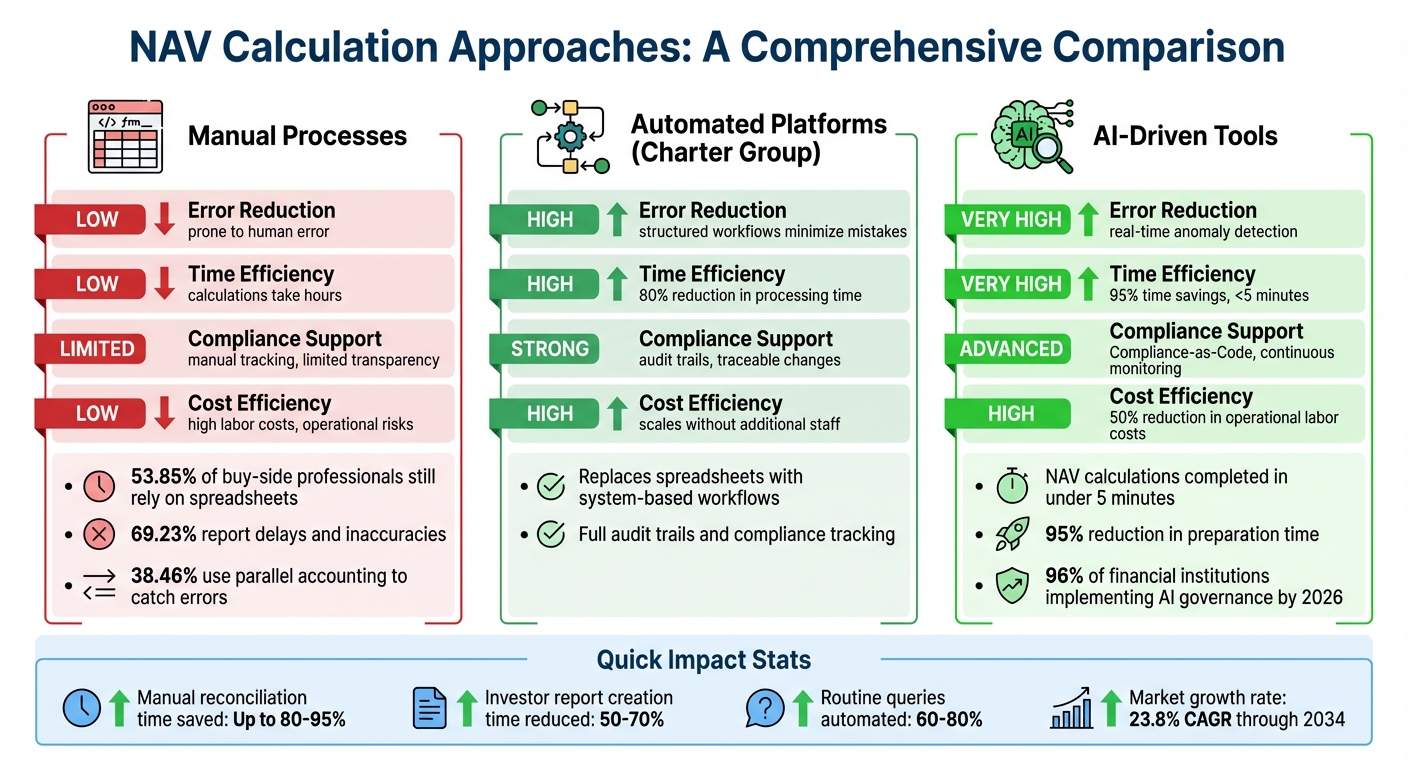
NAV Calculation Methods Comparison: Manual vs Automated vs AI-Driven
Zero Touch NAV | 100 % Automations in NAV calculations of Hedge Fund | Mutual Fund | PE and VC
sbb-itb-9792f40
1. Manual NAV Processes
Even today, many fund administrators stick with manual NAV calculations, despite the clear challenges they present. Over half (53.85%) of buy-side professionals still rely heavily on spreadsheets and manual processes for NAV oversight. This reliance creates a shaky foundation for one of the most critical aspects of fund administration.
Error Reduction
Manual processes are riddled with opportunities for mistakes, which directly contribute to the issues highlighted earlier. For instance, reconciliation gaps arise when administrators manually input data from various sources – brokers, custodians, and internal systems often don’t align seamlessly. Errors such as incorrect accruals for fees or performance allocations can skew returns, while valuation mistakes due to outdated pricing or missing data feeds lead to NAV inaccuracies. Misclassifying transactions, like mixing up realized and unrealized gains, further compromises financial reporting. As Cartesian FinOp Partners puts it:
Accuracy isn’t just a bookkeeping issue – it’s a credibility factor. Even small hedge fund accounting mistakes can ripple through your NAV misstatements, investor reporting, and allocator relationships.
The impact is widespread: 69.23% of professionals report experiencing delays and inaccuracies in NAV publication. These delays not only affect subscription and redemption pricing but also highlight the inefficiencies of manual workflows.
Efficiency
Manual NAV processes also come with a hidden cost – time. Administrators spend countless hours reconciling transactions and updating valuations, which slows down the entire workflow. The lack of transparency in these processes makes it harder to establish clear audit trails. To mitigate errors, 38.46% of respondents rely on partial or full parallel accounting practices, essentially doubling their workload. This reactive approach forces teams to focus on repetitive tasks instead of dedicating time to more strategic, value-driven analysis or leveraging AI hedge fund administration to streamline operations. The inefficiencies don’t just waste time – they also exacerbate compliance challenges.
Compliance Features
Manual workflows also introduce compliance risks that can shake regulatory confidence. Nearly half (46.15%) of professionals feel there’s a lack of transparency in manual NAV calculations. Without built-in control mechanisms, compliance teams face an uphill battle in verifying accuracy. Even when fund managers outsource calculations, they remain accountable for NAV accuracy, and manual errors can lead to serious regulatory consequences. The heavy reliance on spreadsheets in manual processes adds another layer of operational risk, which regulators are scrutinizing more closely. As Indus Valley Partners notes:
The prevalence of operational risks and delays in NAV publication has proven to be a critical stumbling block, affecting the timely and accurate delivery of NAV information.
These risks ultimately increase operational costs and strain regulatory relationships.
Cost Effectiveness
At first glance, manual processes might seem like a cheaper option since they don’t require upfront software investments. However, the hidden costs add up quickly. Extensive manual reconciliations and error corrections drive up operational expenses. Additionally, layered oversight – where multiple team members verify calculations – requires more staff, further increasing costs. And when mistakes do slip through, the consequences are costly: NAV restatements, investor notifications, potential legal issues, and reputational damage can easily outweigh any perceived savings from avoiding automation.
2. Charter Group Fund Administration Platform
Charter Group Fund Administration offers a platform designed to replace outdated manual processes with a streamlined, automated approach. This advanced system takes care of tasks like NAV calculations and regulatory reporting, freeing fund managers from the constraints of spreadsheets so they can focus on their core investment strategies.
Error Reduction
One of the platform’s standout features is its ability to minimize errors through automation. Instead of relying on administrators to manually input pricing from various sources, the system automatically aggregates and reconciles data from brokers, custodians, and internal records. This is particularly crucial for funds dealing with complex instruments, derivatives, or crypto assets, where even minor miscalculations in fee structures can result in significant NAV discrepancies. For Commodity Trading Advisors, the platform goes a step further by providing independent NAV and return reviews, ensuring an additional layer of third-party verification to bolster the credibility of reported returns.
Efficiency
With the Charter Group platform, fund managers can reclaim valuable time previously spent on manual reconciliations and updates. The system generates clear, actionable reports that are ready for immediate use, eliminating the need for further data interpretation. For listed funds, the platform automates the delivery of ongoing Net Tangible Asset (NTA) or NAV updates directly to global exchanges such as the CSX and ISE. This automation removes the burden of manually preparing and submitting reports. Lawrie Chandler, Director at Edale Group, shared his experience:
The Charter Group team provide the administration for a Cayman Islands offshore fund for an advisory client of Edale. Their systems and day to day business operation and support were first rate.
Compliance Features
The platform simplifies regulatory compliance for offshore jurisdictions like the Cayman Islands and BVI. It handles FATCA and CRS 2.0 requirements, including the upcoming 2026 Cayman Islands updates, such as assigning a Cayman-resident Principal Point of Contact and incorporating new data fields. By maintaining detailed audit trails and automated controls, the system reduces the compliance risks often associated with spreadsheet-based workflows.
Cost Effectiveness
Though the platform requires an initial investment in professional administration services, it delivers measurable savings by cutting operational overhead and improving accuracy. Fund managers can avoid the expense of maintaining parallel accounting systems – used by 38.46% of firms to catch manual errors – and reduce the risk of costly NAV restatements. Additionally, the platform’s ability to manage specialized asset classes eliminates the need for separate systems or additional staff to handle these instruments. These efficiencies also pave the way for future advancements, including AI-powered tools, to further enhance operations.
3. AI-Driven Data Extraction Tools
AI-driven data extraction tools use machine learning to handle massive datasets with speed and precision. These tools replace manual data entry, a common source of errors in traditional spreadsheet workflows. Instead of relying on repetitive copy-pasting, AI systems pull data from various sources – like trade files and blockchain transactions – and continuously cross-check the information for accuracy.
Error Reduction
One of the standout benefits of these tools is their ability to minimize human error. They proactively detect inconsistencies, flagging incomplete tasks or missing approvals through automated validation steps. Advanced analytics also identify subtle anomalies and recurring patterns in historical data that might otherwise go unnoticed. Karl Rohloff, Director at Grant Thornton Advisory Services, highlights this capability:
The real value of AI comes when exceptions are filtered to focus on what matters. Operations teams need to know why something was flagged so they can act with confidence instead of chasing noise.
These platforms integrate "Compliance-as-Code", embedding regulatory and internal rules directly into workflows. Every transaction is automatically checked against machine-readable rulesets in real time, reducing the reliance on key personnel and minimizing risks tied to manual processes.
Efficiency
AI workflows dramatically speed up processes like NAV (Net Asset Value) calculations, cutting manual processing time by as much as 80%. Sumit Sharma from NAV Fund Services notes:
AI‑driven workflows have reduced NAV preparation time by 95%, enabling rapid completion of NAV calculations.
These platforms handle vast amounts of data and produce detailed performance reports in real time. Features like one-click report generation and natural language querying provide quick insights for team members, while real-time dashboards track metrics like service level agreement compliance, turnaround times, and approval delays. This replaces the outdated, static monthly reports of older systems.
Compliance Features
AI tools bolster compliance by maintaining immutable audit trails, logging every calculation, review, and sign-off with precise timestamps. This ensures an inspection-ready record for internal and external audits. Using Natural Language Processing (NLP) and Optical Character Recognition (OCR), these systems scan legal documents – such as Limited Partnership Agreements and Private Placement Memorandums – to extract critical terms and tax-related data needed for CRS and FATCA compliance. Unlike periodic manual checks, AI continuously monitors for discrepancies. By 2026, around 96% of financial institutions have implemented AI governance controls, reflecting the growing reliance on these tools for compliance. Additionally, enterprise-grade AI solutions automatically identify and redact sensitive information, like Social Security numbers and account details, before processing or storage. These features not only strengthen compliance but also enhance operational reliability.
Cost Effectiveness
Although these tools require an initial investment in technology infrastructure, they lead to significant cost savings by cutting down on manual reconciliation efforts. Automation of data consolidation and anomaly detection can slash operational labor costs by nearly 50%. By handling routine tasks like number-crunching and data aggregation, AI allows firms to redirect staff to more strategic, high-value work. Furthermore, AI-driven reporting frameworks can reduce the time needed to create customized investor reports by 50% to 70%, while automating 60% to 80% of routine investor queries. With the asset management market growing at a compound annual rate of 23.8% through 2034, the adoption of these solutions is clearly accelerating.
Advantages and Disadvantages
Choosing the right approach to NAV calculation involves balancing the strengths and weaknesses of each method. Manual NAV processes, often reliant on Excel, come with notable risks: formula errors, data entry mistakes, dependence on a few key individuals (creating continuity issues), and hidden labor costs tied to the time spent on repetitive reconciliations. Automated platforms, on the other hand, mitigate these risks by streamlining workflows and reducing human intervention.
Charter Group Fund Administration’s platform addresses many of these challenges by replacing error-prone spreadsheets with structured, system-based workflows. It incorporates automated validation libraries that any trained team member can use, ensuring consistency and accuracy. The platform also provides full audit trails and traceable changes, simplifying compliance reviews. By integrating treasury, accounting, and reporting into a single cloud-based system, Charter Group reduces overall operational costs while meeting the precision and transparency standards required by auditors. Its specialized capabilities for crypto funds and offshore jurisdictions make it particularly valuable for firms navigating complex regulatory landscapes.
Taking automation a step further, AI tools enhance both speed and data reliability. AI-driven data extraction tools use machine learning to reconcile data from multiple sources and flag anomalies in real time. These tools can cut NAV preparation time by 95%, completing calculations in under five minutes compared to the hours required for manual methods. They also embed regulatory rules directly into workflows through Compliance-as-Code, ensuring compliance is proactive rather than reactive. However, implementing AI systems can be complex and may require significant adjustments in organizational culture.
Here’s how these three approaches compare across key operational factors:
| Feature | Manual NAV Processes | Charter Group Platform | AI-Driven Data Tools |
|---|---|---|---|
| Error Reduction | Low; prone to human error | High; structured workflows minimize mistakes | Very High; real-time anomaly detection and cross-referencing |
| Efficiency | Low; calculations take hours | High; automation reduces time by up to 80% | Very High; 95% time savings, with calculations done in under 5 minutes |
| Compliance Features | Challenging; manual tracking with limited transparency | Strong; audit trails and traceable changes included | Advanced; continuous monitoring with Compliance-as-Code |
| Cost Effectiveness | Low; high labor costs and operational risks | High; scales efficiently without requiring more staff | High; supports strategic scaling but requires upfront investment |
For smaller portfolios, manual processes might be adequate. However, integrated platforms and AI-driven tools are far better suited for modern fund administration, offering both scalability and accuracy. Manual methods struggle to handle high-volume investor activity. While Charter Group’s platform provides robust automation without the complexity of AI, firms managing tokenized assets or large-scale investor bases may find AI-driven tools indispensable for meeting the demands of today’s fast-paced markets.
Conclusion
Relying on Excel for manual NAV calculations is a risky approach that fund administrators can no longer afford. These methods are prone to formula errors, data entry mistakes, and overdependence on individuals with specialized knowledge of intricate spreadsheets. This not only creates challenges for operational continuity but also introduces compliance risks due to the lack of a clear, transparent audit trail.
Automation provides a much-needed alternative. Charter Group Fund Administration’s platform replaces error-prone, spreadsheet-heavy workflows with a structured, system-driven process. Every change is logged and traceable, ensuring funds are always ready for inspection. Additionally, the platform eliminates reliance on key personnel by enabling any trained team member to manage workflows. By combining accounting, compliance, and reporting into one cloud-based system, it cuts operational costs while meeting the precision standards required by auditors. This is especially beneficial for funds in offshore jurisdictions or those managing crypto assets, where specialized expertise is critical.
AI-powered tools take automation a step further, reducing NAV preparation time by up to 80%. These tools enhance accuracy through real-time anomaly detection and automated reconciliation across multiple data sources. By embedding regulatory requirements directly into workflows, compliance becomes a proactive process rather than a reactive one.
These advancements in automation are reshaping how NAV calculations are performed. Fund administrators must transition away from outdated spreadsheet methods and embrace comprehensive automation. Modular tools that integrate seamlessly with existing IT systems allow for quick implementation without disrupting current operations. While simpler automation might work for smaller portfolios, firms managing complex fund structures, tokenized assets, or high investor activity will gain the most from platforms that improve accuracy, transparency, and competitiveness in today’s fast-moving markets.
FAQs
What data sources should feed into a NAV calculation?
Calculating Net Asset Value (NAV) depends on pulling together data from multiple sources. This includes financial data, asset valuations, liabilities, and capital flow information.
Automation tools can simplify this process significantly. By standardizing how data is collected and processed, these solutions help reduce errors and improve precision – making the results more dependable.
When should a fund move from spreadsheets to automation?
When a fund faces growing complexity, higher transaction volumes, or stricter accuracy requirements, relying on spreadsheets can become a liability. Manual processes often lead to inefficiencies and errors, especially when dealing with private assets, capital flows, or compliance obligations. In such cases, transitioning to automation becomes essential.
Automation not only improves transparency and data integrity but also accelerates reporting – critical for meeting both investor and regulatory expectations. For example, modern tools can drastically cut down the time needed for NAV preparation, making them a game-changer for streamlined and effective fund management.
What controls should an automated NAV workflow include?
Automating a NAV workflow requires incorporating essential controls to maintain both accuracy and compliance. These controls might include approval steps, validation checks, and system-driven tasks. For example:
- Automated posting ensures transactions are recorded efficiently and consistently.
- Data integrity validations help confirm the accuracy and reliability of the information being processed.
- Approval workflows provide an additional layer of oversight, requiring verification and authorization before NAV calculations are finalized.
By integrating these elements, the workflow becomes more streamlined while reducing the potential for errors.