
Pension funds are facing increasing pressure to integrate ESG (Environmental, Social, and Governance) factors into their investment strategies. Hedge fund administration and manual approaches like spreadsheets and fragmented data sources are no longer sufficient to meet regulatory requirements or manage risks effectively. AI is transforming ESG management by automating data processing, providing real-time risk insights, and improving reporting accuracy.
Key takeaways:
- Manual ESG processes are inefficient, with up to 80% of time spent cleaning data and delays of 6-12 weeks for actionable insights.
- AI tools streamline ESG workflows, offering faster risk detection, improved compliance, and better decision-making.
- Examples include the Norway Sovereign Wealth Fund using AI for ESG risk monitoring across 7,200 companies and Brunel Pension Partnership reducing manual review time with AI-powered tools.
- Leading platforms like RepRisk, Truvalue Labs, MSCI, and Sustainalytics offer solutions for risk monitoring, sentiment analysis, and ESG forecasting.
AI is not just helping pension funds meet compliance standards – it’s enabling them to anticipate risks and make more informed investment decisions. However, success depends on reliable data, strong governance, and adherence to regulatory frameworks.
Why Pension Funds Need AI for ESG
Problems with Manual ESG Analysis
Relying on manual ESG analysis creates significant inefficiencies for pension funds. For starters, teams spend as much as 80% of their time cleaning fragmented data from sources like PDFs, spreadsheets, surveys, and even documents in multiple languages. This leaves little room for actual analysis or drawing meaningful insights.
Adding to the challenge is the lack of standardization. Inconsistent methodologies can lead to ESG scores for the same company differing by up to 50%. This variability makes it incredibly difficult for pension funds to confidently assess risks and make informed decisions.
Manual processes also come with costly delays. Traditional workflows often result in a 6-to-12-week gap between data collection and actionable insights. In fast-moving markets, this lag forces funds into a reactive stance, addressing risks after they’ve already materialized instead of anticipating them.
Another limitation is the inability to process qualitative data effectively. Manual tools often miss critical signals, like worker feedback or policy nuances, which can highlight emerging ESG issues early on. These qualitative insights are crucial for identifying potential problems before they escalate, yet manual methods simply can’t handle them at scale.
These challenges make it clear why pension funds need AI to deliver faster, more reliable ESG intelligence.
How AI Improves ESG Performance
AI offers a game-changing solution by automating data processing and delivering real-time risk evaluations. For instance, Large Language Models can analyze thousands of companies within 24 hours to flag issues like corruption or fraud. This is especially impactful in emerging markets, where local news often doesn’t reach global audiences, leaving risks hidden from traditional analysis.
Take the example of the National Employment Savings Trust (Nest), which manages over 13 million members. In 2022, Nest integrated Clarity AI data with the Aladdin® platform to streamline its ESG monitoring. Katharina Lindmeier, Head of Sustainability Strategy at Nest, shared:
We use Clarity AI data to develop a dashboard which sets out the different portfolios’ exposures to key ESG risk areas as well as compliance with individual mandates. For example, we have used Clarity AI exposure data to help us identify whether managers may have breached our fossil fuel screens.
AI also enhances long-term tracking through persistent unique IDs, linking assessments, corrective actions, and outcomes over time. This feature is essential for meeting regulatory requirements like those outlined in the Corporate Sustainability Due Diligence Directive (CSDDD). Instead of relying on isolated data snapshots, pension funds can now demonstrate how their due diligence efforts are actively reducing harm.
Natural Language Processing (NLP) takes things a step further by analyzing qualitative data at scale. AI can identify themes in policy documents and interpret worker narratives, adding depth to quantitative ESG scores. This shift enables pension funds to move beyond compliance-focused reporting and embrace strategic, forward-thinking decision-making. The growing demand for these capabilities is evident, with the supply chain ESG due diligence market projected to hit $5.33 billion by 2033, growing at a 14.2% annual rate.
AI is not just a tool – it’s becoming a necessity for pension funds aiming to stay ahead in the evolving ESG landscape.
sbb-itb-9792f40
Leading AI Tools for ESG in Pension Funds
RepRisk: ESG Controversy Monitoring
RepRisk combines machine learning with expert analysis to spot reputational and business conduct risks before they escalate. The platform scans 150,000 public sources daily in 30 major business languages, covering over 95% of the global GDP. This multilingual capability ensures that even local-level controversies, often missed by English-only tools, are detected.
Their "Human Intelligence (HI) x AI" model is a standout feature. Over 150 analysts validate findings generated by AI, ensuring accuracy and depth. Currently, RepRisk monitors 335,057 companies and 110,861 projects across 34 sectors globally, boasting a client retention rate of over 95%. Impressively, 80% of top investment managers rely on RepRisk for daily monitoring. Even the Norwegian Global Pension Fund, the second-largest sovereign wealth fund globally, has used RepRisk since 2009 to screen for environmental and social risks.
Standard Chartered emphasized the platform’s practical benefits:
"RepRisk also offers a ‘reality check’ to company-provided information, to help us determine how successfully a company’s policies are being implemented."
RepRisk has also introduced Thematic Due Diligence Scores, a first in the industry. These scores allow for in-depth evaluations of specific ESG themes, such as labor rights or environmental compliance. This innovation played a role in earning the company recognition as Best KYC Surveillance Provider in 2025. Other platforms are also advancing their real-time ESG insights with cutting-edge AI techniques.
Truvalue Labs: Real-Time ESG Insights
Truvalue Labs leverages AI to continuously gather ESG data from a wide range of sources, including news, regulatory filings, and social media. It organizes this information into specific ESG categories and quantifies sentiment, producing constantly updated ESG scores. This helps pension funds identify emerging risks early, before they can impact portfolio values. Its seamless integration with major investment management systems makes it easier for teams to incorporate these insights into their workflows.
BCI’s AI-Driven ESG Forecasting Tools
The British Columbia Investment Management Corporation (BCI) has developed AI tools focused on ESG forecasting and due diligence. These tools use predictive modeling to anticipate future risks, such as potential carbon emissions or supply chain disruptions. By automating the extraction of both quantitative and qualitative ESG data from unstructured sources, BCI’s approach not only boosts efficiency but also helps funds stay ahead of regulatory changes and market trends.
Sustainalytics: Predictive ESG Risk Models
Sustainalytics offers AI-powered analytics designed to assess ESG risks and support sustainable investment strategies. Its predictive models evaluate how well companies manage material ESG issues, giving pension funds a forward-looking view of potential risks. By automating data extraction from filings and third-party sources, Sustainalytics enables a shift from basic exclusion screening to active, portfolio-wide ESG risk management.
MSCI AI-Driven ESG Ratings
MSCI AI Portfolio Insights uses generative AI to uncover anomalies and analyze trends in pension fund portfolios. The platform identifies risk drivers and issuer sentiment early, giving managers time to make adjustments before risks materialize. It integrates with platforms like Snowflake, allowing funds to perform ad hoc analyses and merge ESG data into their workflows. Additionally, its GenAI capabilities simplify complex risk data into concise summaries and dynamic visuals. One standout feature is real-time monitoring with "fast-exit" capabilities, enabling indices like the SPDR S&P 500 ESG to remove companies breaching risk thresholds within two business days.
#243 How can you leverage AI for ESG and Sustainability reporting
Comparing AI Tools for ESG Monitoring
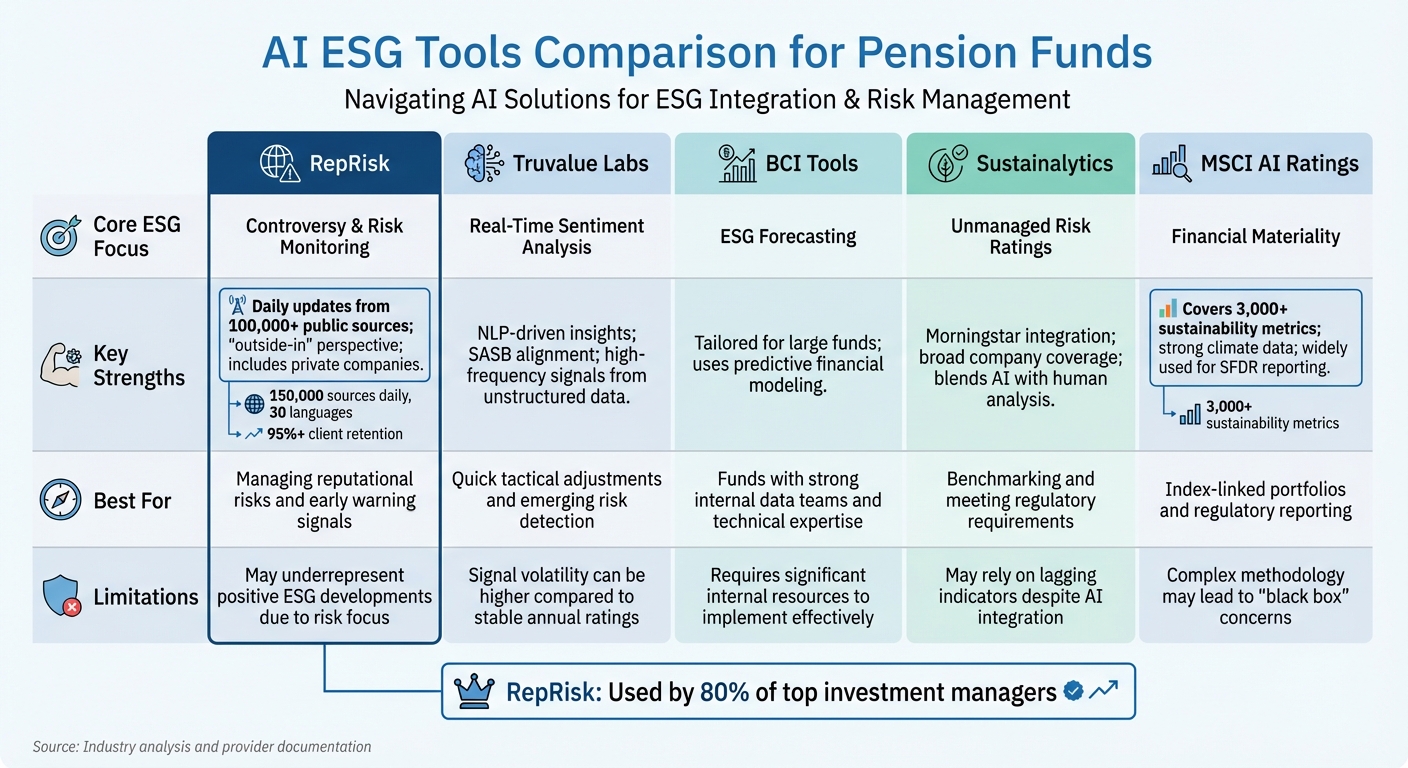
AI ESG Tools Comparison for Pension Funds: Features and Suitability
Comparison Table
With pension funds increasingly turning to AI for ESG oversight, understanding the strengths and gaps of these tools is key. Each tool brings something different to the table. RepRisk excels in daily controversy monitoring, while MSCI provides extensive support for regulatory compliance. Truvalue Labs is ideal for funds that need to react quickly to shifting sentiment, and BCI’s proprietary tools are designed for institutions with advanced technical capabilities, offering strong predictive insights. Here’s a breakdown to help pension funds identify the best fit for their needs:
| Tool | Core ESG Focus | Key Strengths | Pension Fund Suitability | Limitations |
|---|---|---|---|---|
| RepRisk | Controversy & Risk Monitoring | Daily updates from over 100,000 public sources; "outside-in" perspective; includes private companies | Great for managing reputational risks and providing early warning signals | May underrepresent positive ESG developments due to risk focus |
| Truvalue Labs | Real-Time Sentiment Analysis | NLP-driven insights; SASB alignment; high-frequency signals from unstructured data | Best for funds needing quick tactical adjustments and emerging risk detection | Signal volatility can be higher compared to stable annual ratings |
| BCI Tools | ESG Forecasting | Tailored for large funds; uses predictive financial modeling | Suited for funds with strong internal data teams and technical expertise | Requires significant internal resources to implement effectively |
| Sustainalytics | Unmanaged Risk Ratings | Morningstar integration; broad company coverage; blends AI with human analysis | Common choice for benchmarking and meeting regulatory requirements | May rely on lagging indicators despite AI integration |
| MSCI AI Ratings | Financial Materiality | Covers over 3,000 sustainability metrics; strong climate data; widely used for SFDR entity-level reporting | Ideal for index-linked portfolios and regulatory reporting | Complex methodology may lead to "black box" concerns |
RepRisk stands out for its daily updates, a frequency that traditional ESG rating agencies rarely match, as they usually refresh ratings annually or semi-annually. This makes it particularly useful for addressing controversies as they arise. Meanwhile, regulatory bodies like the UK Pensions Regulator are already leveraging AI to analyze investment strategies, flagging high-risk schemes that deviate from standard practices. This growing regulatory focus highlights the importance of tools that not only identify ESG risks but also provide transparent methodologies to meet compliance demands.
AI Workflow Automation for ESG Management
Natural Language Interfaces for ESG Data
Generative AI-powered natural language interfaces are changing the game for pension fund managers by making it easier to navigate complex ESG datasets. Instead of manually sifting through metrics or reports, managers can simply ask questions like, "Which portfolio companies have the highest Scope 3 emissions?" or "What is our fossil fuel exposure in emerging market funds?" This intuitive approach can save around 10 hours per report.
Automated dashboards further simplify the process by helping pension funds monitor multiple external fund managers. These tools make quarterly review meetings quicker and more precise by removing the need to jump between spreadsheets and sustainability reports. The result? Teams can dedicate more time to strategic analysis instead of getting bogged down in tedious data extraction.
And it doesn’t stop there – AI agents go beyond simple queries to refine and streamline entire ESG decision-making workflows.
AI for Better Investment Decisions
AI agents are transforming ESG workflows by automating essential tasks like data collection, normalization, and anomaly detection. For example, these systems can take unstructured data from sources like utility bills, supplier reports, or PDFs and turn it into structured, audit-ready formats. They also flag inconsistencies and fill in data gaps using established industry standards. This level of automation has been shown to cut compliance costs by as much as $80,000 while tripling the production of annual ESG reports.
A real-world example comes from February 2026, when Norway Bank Investment Management (NBIM) – which oversees a $2.2 trillion sovereign wealth fund – used large language models to assess ESG risks for about 7,200 companies in just 24 hours. The AI system monitored local-language media to detect risks like corruption and fraud, particularly in emerging markets where such information is harder to track. Thanks to this technology, NBIM identified and exited several high-risk investments ahead of the broader market, avoiding potential financial losses.
Best Practices and Challenges in AI Adoption
Regulatory and Data Privacy Requirements
Pension funds face stringent regulatory requirements when leveraging AI for ESG analysis. The Financial Services AI Risk Management Framework (FS AI RMF), introduced in February 2026, outlines 230 control objectives tailored for highly regulated sectors like pension management. These controls cover essential areas such as governance, data handling, and model monitoring, all of which must meet compliance standards set by regulators.
Data privacy adds another layer of complexity. Amy S. Mushahwar, Partner at Lowenstein Sandler LLP, highlights the risks:
AI governance failures are infrastructure failures running at accelerated speed.
To address this, pension funds need to move beyond viewing privacy as a mere documentation task. Instead, they must embed privacy measures directly into their systems. This includes automated lineage logging and tagging sensitive data at the point of intake. Additionally, modular model architectures are crucial, allowing specific data to be removed for compliance purposes without requiring a complete system retraining.
The stakes are high. In 2024, 60% of S&P companies reported material AI-related risks. Regulators are increasingly mandating the destruction of models trained on improperly sourced data, making robust architectural safeguards non-negotiable. To mitigate these risks, pension funds should establish internal testing environments before full deployment. These environments can help identify potential use cases and security vulnerabilities while ensuring that every AI-generated ESG score can be traced back to its evidence source.
These regulatory hurdles provide a foundation for practical lessons from pension funds that are leading the way in AI adoption.
Lessons from Leading Pension Funds
Case studies from industry leaders offer valuable insights into AI implementation. For example, in August 2025, Railpen – a UK pension manager overseeing £34 billion in assets for 350,000 members – introduced an AI Risk Oversight Framework in collaboration with Chronos Sustainability. Caroline Escott, Co-Head of Sustainable Ownership, explained that the framework is built on four practical pillars: Governance, Strategy, Risk Management, and Performance Reporting. She emphasized the fund’s responsibility to its members:
As a long-term investor and a universal owner of assets, we have a duty to members to understand and act upon evolving risks and opportunities that could affect our portfolio companies as well as the wider health of the economy and financial markets.
Meanwhile, the Swedish Fund Selection Agency (FTN) adopted a different strategy in January 2026. Under Executive Director Erik Fransson, FTN signed three-year agreements with Clarity AI and MSCI ESG Research. These AI tools enforce sustainability requirements, including a 5% cap on thermal coal turnover, across fund managers in Sweden’s premium pension system.
However, challenges remain. In 2023, Calstrs postponed its annual climate report due to significant data integrity issues in calculating its carbon footprint. This setback highlights a critical truth: data quality is the cornerstone of successful AI adoption. As PASA guidance aptly states:
The value of AI depends entirely on the quality and integrity of the data behind it.
To ensure readiness, pension funds should rigorously assess their data quality and establish governance frameworks specifically tailored for AI oversight before rolling out new systems.
Conclusion
AI tools are reshaping how pension funds handle ESG performance and navigate regulatory requirements. Organizations leveraging AI-driven ESG management have reported a 24% boost in sustainability metrics, while cutting ESG reporting time by up to 70%. These advancements mark a shift in how ESG management is approached.
Gone are the days of relying solely on static annual reports. As Pulsora highlights:
Sustainability data is now investor-grade – it must be auditable, defensible, and explainable, not just disclosed.
This shift doesn’t just meet regulatory expectations – it also strengthens strategic decision-making. AI brings the traceability and transparency that regulators demand, with specialized platforms achieving over 90% accuracy in extracting and organizing ESG data.
For pension funds, success depends on blending robust governance with advanced technology, all built on reliable data. Managing long-term commitments for hundreds of thousands of members requires more than efficiency – it demands proactive risk management. With 90% of firms identifying regulatory divergence as a key challenge, AI empowers funds to move beyond mere compliance. It allows them to adopt a forward-looking approach, spotting risks and opportunities before they affect portfolio outcomes.
The pressing question now is how quickly pension funds can implement AI solutions while ensuring strong data governance and adherence to compliance standards.
FAQs
What ESG data should we fix before using AI?
Before using AI for ESG purposes, it’s essential to tackle challenges related to data quality, consistency, and completeness. Many ESG datasets suffer from being fragmented, unreliable, or non-standardized. Addressing these issues ensures that the information is accurate, comparable, and ready for meaningful analysis. Building this solid data foundation is key to making AI-powered insights effective and actionable in ESG decision-making.
How can AI-based ESG results be proven auditable?
AI-driven tools can make ESG results auditable by automating the extraction, analysis, and documentation of ESG data. These tools provide traceability, help meet regulatory requirements, and enable systematic verification of ESG performance. The detailed records they produce play a key role in supporting both evaluation and auditing processes.
Should we buy an ESG AI tool or build one in-house?
Deciding whether to buy or build an ESG AI tool comes down to a few key factors: cost, customization needs, and available resources.
Off-the-shelf tools are appealing because they’re ready to go. They deliver efficiency, provide real-time insights, and handle automated compliance – a great choice if you need something up and running quickly. On the other hand, building an in-house tool lets you create a solution tailored to your exact needs. But there’s a catch: it demands a hefty investment in both technology and skilled talent.
For most pension funds, the practical route is purchasing a proven, scalable tool. It’s often more budget-friendly and saves time compared to starting from scratch.